
 Vietnam
 English
SUSTAINABILITY
MESSAGE FROM THE CHAIRMAN
For nearly 30 years of establishment and growth, from a company supplying a modest range of billets, VAS has now evolved into a strong and comprehensive ecosystem. This ecosystem is built on key pillars that are interconnected and mutually supportive for sustainable development: a modern steel mill complex, a deep-water port system capable of receiving large vessels, and integrated services in stevedoring, logistics, and inland transportation. Today’s development is closely tied to a long-term vision – sustainable growth that delivers the best efficiency for businesses while contributing enduring value to people and society. Our guiding spirit is embodied in the action motto: Dynamism, Dedication, Thoughtfulness, Courage, and Perseverance – underpinned by a commitment to Ethical Principles and Codes of Conduct of the highest standards.
Our motto consistently guides the management practices of the VAS leadership as well as the daily operations in production and business activities of every employee. Thanks to this philosophy, we have built and maintained strong, enduring partnerships with numerous clients and stakeholders over the years.
The Code of Ethics and Conduct lays out the fundamental principles and high ethical standards that govern all activities within the VAS system. It requires every individual in the organization to comply with applicable legal regulations and business practices. By adhering to these principles and standards, we are guided towards becoming a responsible and accountable organization – protecting employee health and safety, managing the workplace with responsibility and respect, while minimizing operational risks, including those that may affect the reputation and credibility of VAS.
We are firmly committed to fostering and maintaining a positive working environment built on openness, respect, and constructive communication. This is the foundation for nurturing a culture of integrity and responsibility across our organization. I urge all employees to take the time to read, understand, and apply this Code when facing challenges in their work. By working with integrity, we ensure that VAS’s reputation continues to grow, strengthen our position as a trusted business partner, and pave the way for VAS to become a dynamic and successful organization in the years ahead.
Regards,
Nguyen Bao Giang
The Chairman of VAS
CODE OF ETHICS AND CONDUCTS
1. INTRODUCTION TO THE CODE OF CONDUCT
The Code of Ethics and Conduct [“the Code”] sets out the standards on core values and responsible conduct for everyone working at the VAS System. We believe that these core values are crucial to the success of the business, and this responsibility lies not only with the Leadership but also with every member of the organization.
CORE VALUES
We are all required to clearly understand and fully embrace the following principles:
❖ Corporate Culture
Corporate culture is the integration of values, ethical standards, business philosophy, scope of compliance, business ideas, management methods, and rules of conduct that are collectively acknowledged and followed by all members of the organization.
VAS emphasizes human values, aiming at the comprehensive development of its people as the ultimate goal, while contributing to the community and society.
❖ Vision
The aspiration to become one of the leading economic organizations in Vietnam, developing sustainably, delivering the best returns for investors, and providing the best living conditions for all employees.
❖ Business Philosophy
For nearly 30 years of formation and development, the VAS System has never separated from its business philosophy. The philosophy below serves as a compass guiding the sustainable growth of the organization.
✓ Always listen, learn, be creative, improve, and collaborate to bring the best benefits to the company and its partners;
✓ Be transparent, act with integrity, and uphold reputation in business management;
✓ Build a professional working environment that fosters long-term commitment for employees;
✓ Take responsibility toward the community.
❖ Brand
A brand is an asset, a reputation, and the trust of customers and partners in the company. Among these, human resources are the most important foundation for brand development. VAS always considers each employee as a brand ambassador in interactions with customers, partners, and other members.
❖ Integrity
Integrity is our foundation to build trust and to make appropriate judgments in all situations. Integrity means working honestly, diligently, and responsibly.
❖ Objectivity
We must ensure the highest level of objectivity in handling all situations without being influenced by conflicts of interest between individuals, groups, and the company’s benefits, or being pressured to act against the true nature of the matter.
❖ Empowerment
Recognizing that employees are the key factor for success, the company allows individuals to take responsibility for their decisions, while trusting in their actions and results that benefit the company.
❖ Confidentiality
We must respect the value and ownership of received information, and not disclose any information without authorization from competent authorities or when required by law.
❖ Professional Competence
We must perform our work with the necessary knowledge, skills, and experience. Always strive to improve knowledge, skills, and capacity to adapt to changes in the working environment.
❖ Workplace Equality
Provide opportunities and respect for all employees in a safe and supportive working environment that benefits everyone.
❖ Compliance with Law
We must uphold the spirit of respecting the law. Live and work in accordance with the law.
GUIDELINES
❖ Respect everyone
❖ Align with goals
❖ Focus on processes
❖ Ensure quality from the start
❖ Strive for quality
❖ Deliver value to owners
PARTIES REQUIRED TO COMPLY WITH THE CODE OF CONDUCT
All individuals, departments/units, and organizations under the VAS system are required to read, strictly comply with the Code of Conduct, and report to the Company’s leadership any violations of the Code.
We expect all individuals and organizations, including partners, to agree to comply with the Code of Conduct whenever carrying out any work or service for the VAS system.
RESPONSIBILITIES OF THE LEADERSHIP
The leadership of the VAS system – including the Members’ Council | Board of Directors, the Executive Board, and heads of departments/units of member companies – are especially responsible for thoroughly understanding, practicing ethical conduct, and adhering to the core principles of this Code of Conduct.
Leaders must set an example, establish an absolute spirit of compliance, and must not overlook any suspected or potential violations of the Code of Conduct, regardless of how minor they may seem. At the same time, the highest-level leadership and the Audit Division must be promptly informed of any suspicions of potential violations of this Code so that the VAS system can take appropriate corrective actions.
RESPONSIBILITIES OF THE AUDIT DIVISION
The Audit Division, authorized by the VAS Chairman, is responsible for communicating the contents of this Code of Conduct, thoroughly disseminating them throughout all activities of each individual, department, and unit within the VAS system. Independence, objectivity, and integrity are fundamental principles to ensure that the Audit Division fully fulfills its assigned mission in a fair, transparent, and unbiased manner.
VIOLATION OF THIS CODE
The VAS system will apply disciplinary measures to actions that do not comply with the Code of Conduct, including termination of labor contracts. In addition, without exception, contractors, consultants, individuals, and other organizations may be suspended from work or from providing services if they fail to comply with this Code of Conduct.
REPORTING NON - COMPLIANCE WITH THE CODE OF CONDUCT
All of us have a responsibility to report any suspected signs of potential violations of the Code of Conduct, company policies, or legal regulations. Information can be sent directly or indirectly to the Company’s Board of Management, the Audit Division, or through other reliable sources. Such reports will be forwarded to the Board of Management to ensure timely disciplinary or corrective action.
NON - RETALIATION POLICY
It is important that everyone feels safe when raising questions and concerns. The company will take all questions, concerns, and issues seriously, confidentially, and in compliance with the non-retaliation policy. Any retaliatory actions against suppliers or individuals who raise concerns in good faith will not be tolerated. Good faith means reporting honestly, sincerely, and based on accurate facts. Conversely, providing false or misleading information that harms the reputation or credibility of individuals or organizations will be considered a violation of the Code of Conduct.
2. BEST ACTIONS FOR THE BENEFIT OF THE VAS SYSTEM
RECOGNIZING AND AVOIDING CONFLICTS OF INTEREST
Conflicts of interest may potentially arise when the interests of an individual or organization affect thecommon interests of the System. We must avoid conflicts of interest so they do not cause difficulties inperforming work objectively and making sound decisions. If there is any potential or actual conflict of interest, the individual is responsible for immediately reporting it to their direct supervisor or the designated point of contact.
RELATIONSHIPS IN THE WORKPLACE
Overly close personal relationships with others in the workplace can create risks of improper behavior or unprofessionalism, especially if involving colleagues in positions of control, influence, or decisionmaking over another’s work. Friendships or close relationships must not influence fairness and objectivity, and must avoid conflicts of interest. Such relationships should be transparently reviewed and assessed to ensure compliance with standards.
BUSINESS RELATIONSHIPS
We must not have any interests or private business relationships with any suppliers, agents, customers, or competitors of the VAS System. Such interests or relationships may influence decision-making related to activities that negatively impact the organization’s interests.
OUTSIDE ACTIVITIES
We must not work for or provide services to any third party that may compete with or supply goods and services to the VAS System. At the same time, all outside work must be disclosed so that the Management Board has the basis to properly arrange personnel for each specific position or project, ensuring that no conflicts of interest exist during implementation.
PROTECTION OF ASSETS AND INFORMATION
❖ Physical Assets
To perform our work, we need access to appropriate resources, including equipment, facilities, vehicles, materials, and goods of the VAS System. These resources are only to be used for authorized activities. We are all responsible for protecting these assets from loss, damage, theft, misuse, and waste.
❖ Intellectual Property
We are also responsible for identifying, managing, and protecting the intellectual property of the VAS System. Intellectual property includes patents, trademarks, copyrights, trade secrets, processes, and production know-how. All intellectual property created during work belongs to the organization and must not be used for personal purposes. In addition, we must respect the intellectual property of others, including competitors, and not infringe upon their rights.
❖ Confidential Information
Confidential information is data that ensures the VAS System maintains its competitive business advantage and could be harmful if disclosed externally. Confidential information includes financial data not publicly available, technical data, proprietary software, and personal information about customers or suppliers. It also includes information collected from third parties that we are obligated to keep confidential. We are entrusted to protect confidential and sensitive information at all times and in all places.
If we lose devices, documents, or any items containing confidential information of the VAS System [e.g., laptops, mobile phones, or storage devices], we must immediately report to the IT department or our direct manager for appropriate protective measures.
MEDIA AND SOCIAL NETWORKS
Media has changed the way we share information, and these actions can create new opportunities but also bring responsibilities and risks.
Social networks include Facebook, Twitter, blogs, image-sharing sites, videos, forums, chat rooms, and many other platforms. If the Company requires us to post on these networks, we may only share information that complies with regulations. In personal interactions on media and social networks, we must be extremely careful to protect the reputation and confidential information of the VAS System.
EXTERNAL COMMUNICATIONS
The way we communicate with the public is very important – it must be honest, accurate, and consistent. Public information about the VAS System is the responsibility of senior management and authorized spokespersons. We are all responsible for ensuring that information not authorized for disclosure is not shared on news sites, media channels, or any other forums that may lead to the release of Company information. We are not allowed to disclose information about the organization unless authorized to do so. If this rule is violated, it may cause damage to the Company’s reputation or interests. All media requests or inquiries must be directed to the Company’s Management.
PROPER USE OF ASSETS
We must also use assets, including production equipment, computers, telephones, and information systems, in a legal, appropriate, and efficient manner. The use of these assets for personal purposes must be limited, reasonable, and not affect our ability to perform work or violate the policies of the VAS System or legal regulations. We must return all assets or equipment when work assignments are completed or upon termination of employment with the VAS System.
3. COMMITMENT TO EMPLOYEES
EQUALITY AND RESPECT IN THE WORKPLACE
Each of us plays an important role in creating a work environment that actively promotes fairness and mutual respect. The VAS System highly values dedicated and energetic employees, who, through their daily efforts, create superior value for customers, owners, and business partners. The diversity of skills and perspectives of each individual helps us better understand customer needs and adapt to the everchanging business environment. By working together, we ensure that our workplace remains one of commitment and effectiveness.
We are committed to maintaining a workplace free from any form of unlawful discrimination and in compliance with all current labor regulations. Furthermore, the VAS System is an organization that values equal employment opportunities and makes all employment-related decisions based on the individual’s abilities and the requirements of the position.
We are committed to equality throughout all stages of employment, including recruitment, training, promotion, compensation, benefits, transfers, termination, and other opportunities based on performance.
PRIVACY IN THE WORKPLACE
We are all responsible for protecting privacy and ensuring the confidentiality of personal information that individuals provide or that is collected about them. We must respect the principle that confidential information does not include data owned by the VAS System but refers only to personal information in the workplace.
Personal information may include names, phone numbers, addresses, email addresses, identification numbers, passport numbers, or any information linked to an identifiable individual.
We only collect, access, or use personal data for lawful and legitimate purposes. We may not disclose this information to anyone, inside or outside the Company, without proper authorization. Additionally, we must comply with legal requirements and internal policies to prevent unauthorized access to personal data.
HARASSMENT AND INTIMIDATION IN THE WORKPLACE
Everyone has the right to work in a safe and respectful environment, free from harassment or intimidation. Any inappropriate behavior, harassment, or threats that damage the dignity, values, and direction of the organization are strictly prohibited.
We do not tolerate any form of harassment or intimidation in the workplace, including verbal, written, visual, or physical conduct that harms or demeans others. Sexual harassment and any form of harassment based on gender, race, religion, or other characteristics are absolutely prohibited. Offensive language and behavior are strictly forbidden.
WORKPLACE SAFETY
Promoting and maintaining a safe workplace is essential. Therefore, all aspects of our operations must be carried out in compliance with laws, applicable regulations, industry standards, and company policies related to occupational safety. Our goal is to prevent harm to employees’ health and safety. We never compromise on safety and compliance in exchange for productivity or business results.
All employees are expected to understand and comply with legal requirements and workplace safety regulations applicable to their work area. Following these requirements helps ensure that we do not put ourselves or others at risk. If any unsafe working conditions, damage, or occupational illness related to work are discovered, they must be reported immediately to management or the Safety Committee.Everyone is encouraged to report errors or suggest improvements to enhance our safety programs.
In addition, we are responsible for ensuring that facilities remain secure at all times. This means that we may only access facilities with proper authorization. If we believe someone is attempting to access a part of the VAS System without permission, or if we suspect any illegal or unsafe activity, we must promptly report it to the Security Department or relevant authorities.
WORKPLACE VIOLENCE
All employees have the right to work in a safe environment, without fear or threats of violence. To ensure employee safety, the possession of firearms, explosives, or other dangerous weapons is strictly prohibited within workplace premises.
All threats and acts of violence must be reported to a manager, supervisor, human resources representative, or the security department. In cases where someone is believed to be in immediate danger, we must contact the local law enforcement authorities.
Any act of violence or threat against employees or colleagues is strictly prohibited. All threatening or violent behavior will be subject to investigation, and appropriate disciplinary actions, including termination of employment, will be enforced. Threats or violent acts may manifest in various forms, including:
❖ Direct or indirect threats, whether written or verbal, intended to cause harm or injury;
❖ Words, gestures, or shouting that cause emotional distress or physical injury;
❖ Stalking an individual;
❖ Physical intimidation or assault.
SUBSTANCE ABUSE AND ALCOHOL IN THE WORKPLACE
As part of the organization’s commitment to maintaining a safe and healthy work environment, that prohibits the abuse of illegal substances and alcohol beverages. Being under the influence of such substances may impair performance and violate established safety standards. The use, solicitation, sale, or possession of illegal substances within workplace premises is strictly prohibited.
The consumption of alcoholic beverages on workplace premises is prohibited unless explicitly authorized by the Company’s Management Board. If permitted, alcohol consumption must be conducted responsibly, including off-premises. Violations of this policy will result in disciplinary action, up to and including termination of employment.
4. COMMITMENT TO OWNERS
FINANCIAL REPORTING AND DISCLOSURE
Owners entrust us to maintain accurate and complete corporate books and records, which are critical for evaluating operations and making significant business decisions.
The Board of Directors, Chief Accountant, Audit Division, and accounting personnel are required to understand and comply with accounting policies and applicable financial laws and regulations. Periodically, member companies must submit financial statements and other documents to State regulatory authorities, and we are responsible for preparing and submitting these reports in accordance with legal and regulatory requirements. It is imperative that these reports are prepared with honesty, accuracy, and promptness.
The integrity of financial statements is critically important. Accounting and financial reporting regulations must be fair, reasonable, and compliant with generally accepted accounting principles.
Financial statement fraud is strictly prohibited. Although it is challenging to provide a comprehensive definition of financial statement fraud, in general any intentional act or non-compliance, whether by omission or by commission, that results in a misstatement or an unreasonable presentation of financial statements may be considered fraudulent. Transparent, coherent, and continuous communication between management and employees regarding financial and operational matters significantly reduces the risk of issues in accounting and financial reporting while supporting the achievement of operational objectives.
RECORD KEEPING
We are obligated to maintain comprehensive records to ensure a true and accurate reflection of the organization’s financial position. Records may be stored in paper or electronic format and must include all legal, financial, accounting, tax, personnel, and other documentation as required by the organization’s internal policies and applicable laws.
AUDIT ACTIVITIES
All employees are responsible for cooperating with both internal and independent auditors. Individuals, departments, and organizations must provide auditors with the information they are authorized to access. If there are questions or a need for clarification regarding the information to which auditors are permitted access, we may seek guidance from the Management Board before complying such requests. Strict adherence to the VAS System’s confidentiality policies is required.
We must not engage in actions to coerce, mislead, distort, or unduly influence auditors involved in auditing or reviewing financial statements. Prohibited actions include any direct or indirect conduct that an individual knows or should reasonably know could result in an inaccurate audit report or material misrepresentation of information in financial statements.
ANTI - CORRUPTION AND BRIBERY
All transactions with customers, suppliers, and business partners must be impartial, objective, and free from personal interests or external coercion. We will neither offer nor accept illicit payments. Illicit payments may include cash, gifts, favors, remuneration, travel, entertainment, or other valuable assets used as tools for bribery, kickbacks, or inducements. Such payments expose the Company and individuals to risks, including potential legal violations.
If anyone requests or suggests a bribe, kickback, or inducement, it must be firmly rejected, and the incident must be immediately reported to the Company’s Management Board. Likewise, no one may request or coerce others to pay bribes, inducements, or kickbacks for personal gain, nor ignore signs that someone may be engaging in such misconduct. If there is belief or evidence that someone is offering or accepting illicit payments on behalf of the Company, it must be reported immediately to the Management Board.
In exceptional circumstances where an individual’s health or safety, or that of their loved ones, is threatened unless illicit payments are made, the health and safety of employees and their families are the Company’s priority. As this Code cannot anticipate every scenario, employees must use their best judgment to prioritize their health and safety, even if it involves making an illicit payment. Any such incident must be immediately reported to the Management Board, with an explanation of the circumstances leading to the situation.
GIFT - GIVING AND RECEIVING POLICIES
Maintaining and fostering positive business relationships with customers, suppliers, and partners is critical to the organization’s growth. Reasonable gifts or benefits are courteous exchanges that promote goodwill and strengthen relationships. However, giving or receiving gifts or benefits may create the perception that business decisions are influenced by factors other than fair and objective business criteria. Therefore, we must exercise caution and thorough consideration when giving or receiving gifts in a business context.
We are responsible for ensuring that any gifts or benefits given or received are appropriate and comply with the VAS System’s policies. Avoid gifts or benefits that may compromise, or appear to compromise, the objectivity of the parties involved. Ensure that giving or receiving gifts or benefits does not influence critical decisions. Consult the Company’s Management Board when considering whether to give or receive gifts or benefits to ensure compliance with organizational policies.
Giving or receiving gifts or benefits in a business context raises legal and ethical concerns when done with expectations of reciprocity. We will not suggest or require anyone to provide gifts or benefits in exchange for business opportunities with the Company. Gifts or benefits should not be exchanged during contract negotiations, as they may influence business decisions or undermine the fairness of negotiations and business relationships. Cash or loans must never be given or received as gifts under any circumstances. If uncertain about whether to give or receive a gift or benefit, employees must
5. COMMITMENT TO CUSTOMERS, SUPPLIERS, AND COMPETITORS
GENERAL PRINCIPLES
The VAS System values fairness, transparency, and integrity in all relationships with those we collaborate with, including customers, government agencies, suppliers, distributors, and competitors. We choose to work with those who, like us, operate with integrity and uphold high ethical standards. We are committed to avoiding and not tolerating any form of forced or bonded labor in our supply, production, or distribution chains. We comply with labor laws in the jurisdictions where we operate and expect our partners to do the same. Our business activities must not intentionally harm individuals, communities, or support human rights violations. We strive to protect the environment and expect our partners to act similarly.
PROVIDING QUALITY PRODUCTS AND SERVICES
We are dedicated to delivering high-quality products to our customers. To achieve this, we adhere to internal and external quality control standards governing our business activities, emphasizing safety throughout the product manufacturing process.
RELATIONSHIPS WITH CUSTOMERS
All transactions with current and prospective customers must be fair, transparent, and lawful. The VAS System has built a strong reputation with customers over the years through ethical, high-quality, reliable, and safe products that meet their needs.
RELATIONSHIPS WITH SUPPLIERS
Decisions to procure goods and services from suppliers must be based on quality, service, price, and suitability. The VAS System seeks to establish mutually beneficial, long-term relationships with suppliers based on these factors. We must not accept or expect personal benefits from business transactions with suppliers. We value supplier relationships and aim to procure the best goods and services at competitive prices. Accordingly, we hold suppliers and business partners accountable for the quality and pricing of their products and services.
We are responsible for avoiding conflicts of interest or reporting any perceived conflicts when selecting or purchasing from suppliers. We expect all suppliers to comply with this Code’s provisions on labor, human rights, health and safety, the environment, and fair competition. If we know or suspect a supplier is violating policies or laws, we must immediately notify the Company’s Management Board.
RELATIONSHIPS WITH DISTRIBUTORS AND SALES AGENTS
Our distributors and sales agents are integral to the VAS System’s operations. We acknowledge that distributors are independent businesses and sales agents are not our employees, and we must treat them accordingly. We expect distributors and sales agents to understand and comply with all applicable laws and this Code. If concerns arise about a supplier or sales agent, contact the Management Board of the member company to address those concerns.
FAIR COMPETITION
We believe fair competition benefits businesses, customers, suppliers, distributors, sales agents, and the market. Under no circumstances do we tolerate offering or accepting kickbacks, illegal bribes, or similar illicit payments in exchange for business transactions. We uphold fairness by gathering competitive information through honest and lawful means. If a new employee joins the VAS System from a competitor, we welcome the joining into the workforce but do not accept any confidential information they may have about their former employer’s business. Likewise, we must protect sensitive and confidential competitive information, even after leaving the VAS System.
PROTECTING CUSTOMER INFORMATION
Customers may share confidential information with us to enable us to provide the best goods and services. It is our responsibility to use, store, and protect this information securely in compliance with all applicable legal regulations. We must take necessary steps to safeguard customer information and ensure it is used solely for approved business purposes.
6. COMMUNITY RESPONSIBILITY
MINIMIZING ENVIRONMENTAL IMPACT
We prioritize environmental protection and endeavor to safeguard the environment through our operational processes. We ensure that the workplace is energy-efficient, stable, and environmentally sustainable while complying with legal regulations in the regions where we operate. We dedicate significant resources and important efforts to designing and producing high-quality products that meet customer needs in the most effective and efficient manner. Alongside these efforts, we develop products that adhere to environmental regulations, minimize environmental impact, and promote sustainable use of natural resources. The VAS System complies with Vietnam’s environmental protection laws and regulations. All activities must consider environmental impacts and risks when making business decisions, and it is essential to establish an environmental management system.
POLITICAL, RELIGIOUS, AND CHARITABLE ACTIVITIES
The VAS System and its employees are committed to supporting community programs through financial and other contributions. Employees are free to participate in political, religious, and charitable organizations as individuals based on their personal choices, provided they do not represent the views or actions of the VAS System. When engaging in community activities, we must not use the Company’s confidential information, commercial secrets, or data from customers or suppliers.
Personal external activities must not interfere with job performance at the VAS System. No employee is allowed to coerce others to participate in or support any actions contrary to their personal beliefs regarding political, religious, or charitable events.
7. ENFORCEMENT
This Code of Conduct takes effect from the date of issuance.
All individuals and entities within the VAS System must comply with the provisions outlined in this Code.
Any amendments or supplements to this Code require review and approval by the VAS Chairman.
During performing assigned duties, if we encounter situations that may require us to take actions that violate the provisions of this Code of Conduct, we are responsible for immediately reporting such situations to the Company’s Management Board before taking any action, to ensure that the Company’s interests are always prioritized.
Any individual or entity violating the provisions of this Code will face disciplinary action based on the situation and severity of the violation, in accordance with the labor regulations of the member companies.
HUMAN RIGHTS STATEMENT
COMMITMENTS AND PRINCIPLES
1. Human Rights Declaration
At VAS Group, we believe that the greatness of a business is not only measured by financial figures but also by its steadfast commitment to human dignity. Guided by the philosophy of “Steel Spirit, Strong Heart”, we declare: Respect for Human Rights is an inviolable principle and a core foundation in every decision and action of VAS Group.
This Human Rights Declaration is our formal commitment to building a safe, fair workplace and a sustainable value chain where every individual is treated with respect and fairness.
2. Management Principles
We are committed to complying with and going beyond internationally recognized human rights standards, including the Universal Declaration of Human Rights [UDHR], the United Nations Guiding Principles on Business and Human Rights [UNGPs], and the core conventions of the International Labour Organization [ILO].
These principles are embodied in our Code of Ethics and Conduct [2nd issuance, May 24, 2019] and serve as the compass for VAS Group's People-Centered philosophy.
ORGANIZATIONAL STRUCTURE AND RESPONSIBILITIES
To ensure that Human Rights commitments are implemented consistently and responsibly, VAS Group has established a strict management structure aligned with the Organizational Chart issued under Decision No. 028A/QĐ.22/VASG-HĐQT.
Human Rights Management Council: A dedicated body consisting of leadership representatives from the following Divisions | Departments:
-
Human Resources Division [Headed by HR Director]
-
Legal Department [a qualified representative, preferably a licensed lawyer].
-
Safety Standards Department [a representative from the Technical Division].
-
Employee Representatives [the Union Chairperson and two randomly invited employees to ensure objectivity].
The Council is responsible for strategy development, oversight, and promotion of human rights initiatives across the Group.
-
Implementation Unit: The Human Resources Division serves as the standing unit responsible for daily activities: including training organization, consultation handling, and initial investigation of harassment or discrimination cases.
-
Reporting and Monitoring Mechanism: The Human Rights Management Council reports quarterly to the Executive Board on activities, due diligence results, and complaint handling. Strategic issues, critical risks, and annual summary reports are presented to the Board of Directors to ensure top-level oversight and guidance.
OPERATIONAL AND IMPLEMENTATION SYSTEM
1. Fostering a Culture of Respect for Human Rights
We believe that building a culture of respect for human rights must start with individual awareness and be reinforced by consistent systems.
- Employee Commitment: All employees, including temporary staff, are required to make an annual electronic pledge of ethical conduct and mutual respect when re-signing internal regulations and the “Code of Ethics and Conduct.”
- Mandatory Human Rights Training: Training programs are compulsory for all employees, including:
- In-person training on human dignity, labor rights, and content from the Code of Conduct.
- Online modules on workplace harassment prevention and anti-discrimination
- Awareness Campaigns: Internal communication campaigns are periodically conducted on specific human rights topics and disseminated through company channels.
2. Human Rights Due Diligence [HRDD]
VAS Group systematically implements HRDD to proactively identify, prevent, and mitigate negative human rights impacts arising from its business operations.
2.1 VAS Human Rights Assessment Framework [8 Focus Areas, 30+ Indicators]:
-
Management System Establishment
-
Prohibition of Discrimination
-
Ensuring Freedom of Association
-
Prohibition of Forced Labor
-
Prohibition of Child Labor
-
Ensuring Health & Safety
-
Preventing Harassment
-
Supply Chain Management
2.2 Due Diligence Process:
-
Risk Identification & Assessment: Based on the Assessment Framework, we use methods such as anonymous surveys, in-depth interviews with employees and managers, HR document reviews, and dialogues to identify and assess actual and potential risks.
-
Remedial & Preventive Actions: For units with low scores or high risks, we conduct on-site inspections, root-cause analysis, and propose targeted improvements such as policy revisions, specialized training, or awareness campaigns.
-
Monitoring & Supervision: The effectiveness of improvements is periodically monitored and evaluated to ensure risks are thoroughly addressed.
-
Reporting & Communication: HRDD results are reported to top management and transparently communicated to stakeholders.
3. Grievance and Remediation Mechanism
We operate safe, confidential, and accessible grievance channels, enabling all individuals to report concerns without fear.
3.1 Response Process
|
Step |
1 |
2 |
3 |
4 |
5 |
6 |
|
Process |
Report Receipt |
Immediate Counseling & Protection |
Investigation |
Disciplinary Review |
Remedial Action |
Monitoring & Case Closure |
|
Key Points |
Anyone may report [anonymously or identified] via published channels. |
Provide initial counseling within 24 hours. Immediately separate parties if necessary. |
Objective and confidential fact verification. |
Convene Disciplinary Council. |
Apply disciplinary actions and provide victim support. |
Monitor to prevent secondary harm. Notify reporter of results. |
|
Responsible Unit |
Multi-channel |
HR Department |
Legal Department | Independent Investigation Team |
Disciplinary Council |
HR Department |
HR | Legal Department |
3.2 Remedial Measures and Victim Support
-
Confidentiality Agreement: All involved parties must sign a confidentiality agreement.
-
Comprehensive Support: Upon request, victims receive legal support from the Legal Department, medical cost coverage, and psychological counseling arranged with professionals.
-
Anti-Retaliation: Any retaliation against complainants or victims is strictly prohibited and subject to disciplinary action under the “Code of Ethics and Conduct.”
4. Training and Awareness Raising
We believe that fostering a culture of human rights respect begins with individual awareness.
-
Employee Commitment: All employees, including temporary staff, must renew their annual electronic commitment to ethical behavior and mutual respect.
-
Mandatory Training: All employees must complete online anti-harassment modules and in-person training on human dignity and labor rights.
-
Awareness Campaigns: Regular internal communication campaigns on specific human rights themes are widely disseminated via company channels.
MONITORING AND CONTINUOUS IMPROVEMENT
Sustainable development is a never-ending journey. We are committed to continuous improvement through clear and measurable objectives.
Human Rights Governance Targets for 2025 – 2027
| Category | 2025 Target | 2026 Target | 2027 Target |
|---|---|---|---|
| Human Rights Impact Assessment [HRDD] | Complete methodology and pilot assessment | Expand across operations and plants | Enhance effectiveness and assess suppliers |
| Training Completion Rate | >95% | 100% | 100% |
| Violation Resolution Rate | 100% | 100% | 100% |
STAKEHOLDER IDENTIFICATION TABLE
I. EXTERNAL INTERESTED PARTIES
|
No. |
Interested Party |
Needs / Expectations |
Related Requirements |
Risk if Not Met |
Control / Response Measures |
Communication Method |
Frequency |
|---|---|---|---|---|---|---|---|
|
1 |
Customers [construction contractors, steel traders, dealers] |
|
|
|
|
Email, phone, meetings, customer conferences |
Per order / periodic |
|
2 |
Suppliers [alloys, scrap, electricity, additives, transportation services] |
|
|
Supply chain disruption |
|
Email, phone, on-site assessment |
Daily / quarterly / annual |
|
3 |
State Management Authorities |
|
|
|
|
E-portal, email, meetings |
As regulated |
|
4 |
Local Community |
|
|
|
|
Local meetings, hotline |
Periodic / as required |
|
5 |
Certification Bodies [BoA, Quacert, CARES, ACRS] |
|
ISO standards and certification requirements |
|
|
Assessment, meetings, email |
Annual / periodic |
II. INTERNAL INTERESTED PARTIES
|
No. |
Interested Party |
Needs | Expectations |
Related Requirements |
Risk if Not Met |
Control | Response Measures |
Communication Method |
Frequency |
|---|---|---|---|---|---|---|---|
|
1 |
Board of Directors | Shareholders |
|
Enterprise Law, Company Charter |
|
|
Shareholder meetings, reports, email |
Quarterly / annually |
|
2 |
Company Leadership |
|
Strategic objectives, standards, laws |
|
|
Meetings, reports, email |
Monthly / quarterly / annually |
|
3 |
Employees |
|
Labor Law, Occupational Safety, Fire Prevention |
|
|
Meetings, training, bulletin boards, email |
Daily / periodic |
GUIDELINES
FOR RISK AND OPPORTUNITY ASSESSMENT
I. GENERAL PROVISIONS
1. PURPOSE
- Ensure the quality management system operates effectively.
- Enhance opportunities to achieve the company’s objectives and targets.
- Prevent or reduce undesired impacts and potential errors within the activities of the quality management system.
- Achieve continual improvement within the system.
2. SCOPE OF APPLICATION
- This guideline applies to all departments and units involved in the activities of the quality management systems at VAS Group Nghi Son Joint Stock Company.
3. REFERENCE DOCUMENTS
- ISO 9001:2015 – Quality Management Systems.
- ISO | IEC 17025:2017 – General requirements for the competence of testing and calibration laboratories.
- ISO 14001:2015 – Environmental Management Systems.
- ISO 45001:2018 – Occupational Health and Safety Management Systems.
- TCVN 31000:2018 – Risk Management – Guidelines.
- TCVN 31000:2013 – Risk Management – Risk Assessment Techniques.
4. ABBREVIATIONS
|
Abbreviation |
Explanation |
|
ĐDLĐ |
Management Representative |
|
T|P BP |
Head | Deputy Head Department |
|
HTQL |
Management System |
|
NV liên quan |
Relevant Employee |
|
P. CNVT |
Materials Technology Department |
|
P. QLCL |
Quality Management Department |
5. EFFECTIVENESS
- This guideline shall take effect from the date of issuance.
- Any non-compliance or violation of any provision of this guideline will be handled in accordance with the Company’s Labor Regulations and applicable laws.
- Any amendment, supplementation, or annulment of this guideline must be approved by the Board of General Directors [BTGD].
II. CONTENT
1. FLOWCHART
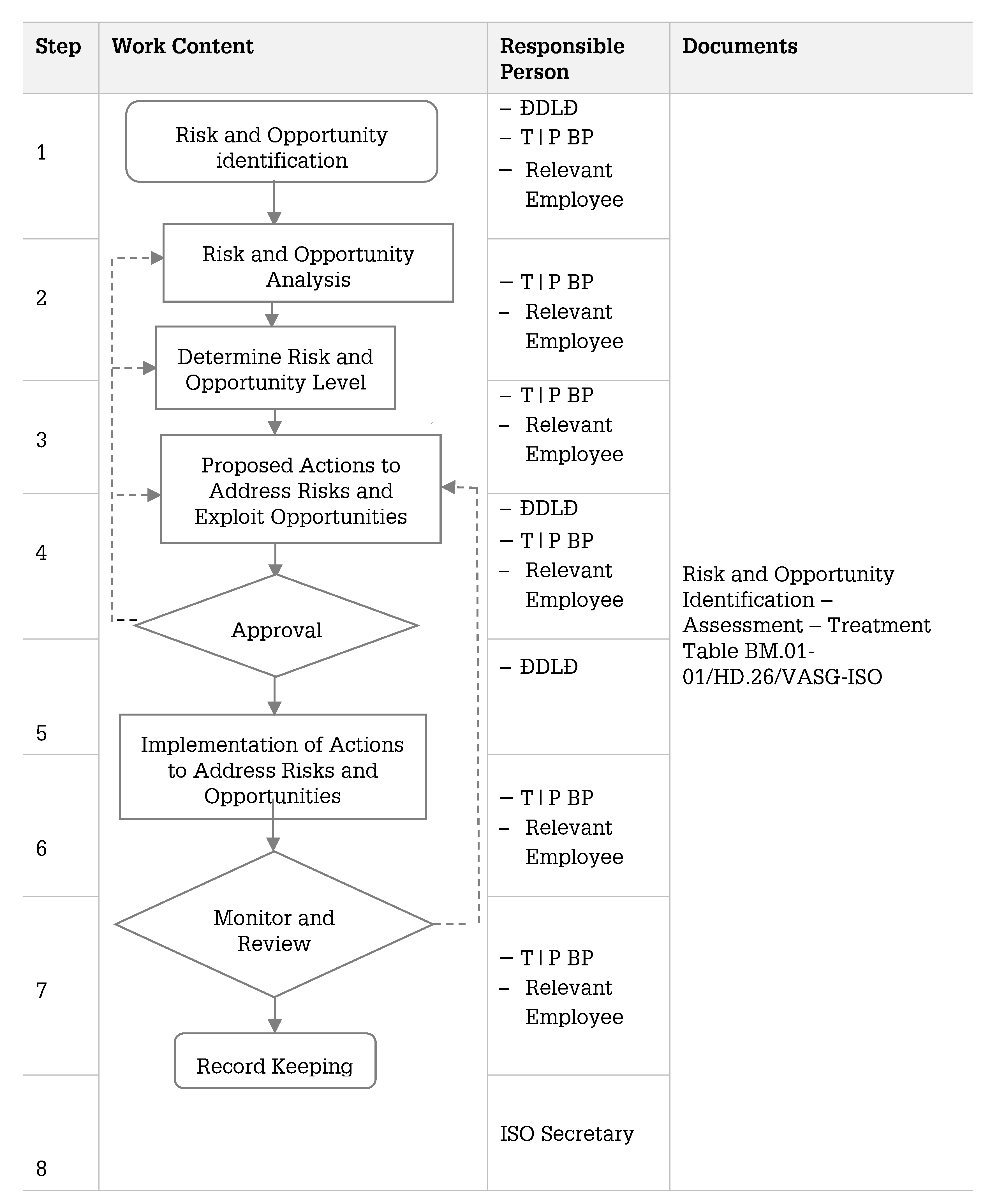
2. EXPLANATION
2.1 RISK ASSESSMENT CONTENT:
|
Steps |
Work Content |
Responsible Person |
|
I |
Risk and Opportunity Identification |
|
|
|
Risk Identification |
|
|
01 |
|
|
|
02 |
|
|
|
03 |
|
|
|
|
Opportunity Identification |
|
|
01 |
|
|
|
02 |
|
|
|
03 |
|
|
|
04 |
|
|
|
II |
Risk & Opportunity Analysis |
|
|
|
Risk Analysis |
|
|
01 |
|
|
|
02 |
|
|
|
|
Opportunity Analysis |
|
|
01 |
|
|
|
02 |
|
|
|
III |
Determine Risk and Opportunity Level |
|
|
|
Determine Risk Level |
|
|
01 |
|
|
|
02 |
|
|
|
03 |
|
|
|
|
Determine Opportunity Level |
|
|
01 |
|
|
|
02 |
|
|
|
IV |
Proposed Actions to Address Risks and Exploit Opportunities |
|
|
|
Proposed Actions to Address Risks |
|
|
01 |
|
|
|
02 |
|
|
|
03 |
Example: The company does not invest in markets with high political instability and does not use suppliers that cannot ensure quality.
Example: Purchasing property and health insurance; outsourcing professional transportation services to reduce the risk of cargo damage.
Example: Training employees in safety procedures to reduce occupational accidents; installing firewalls and security systems to reduce cyber-attack risks.
Example: Maintaining low inventory levels and accepting temporary stock shortages to reduce warehousing costs and bank borrowing. |
|
|
|
Proposed Actions to Exploit Opportunities |
|
|
01 |
|
|
|
02 |
|
|
|
03 |
|
|
|
V |
Approval |
|
|
|
|
|
|
VI |
Implementation of Risk Treatment Measures |
|
|
|
|
|
|
VII |
Monitoring and Review of Risk Treatment and Opportunity Exploitation |
|
|
|
For Risks |
|
|
01 |
|
|
|
02 |
|
|
|
03 |
|
|
|
|
For Opportunities |
|
|
01 |
|
|
|
02 |
|
|
|
03 |
|
|
|
VIII |
Record Keeping |
|
|
|
Retain all records related to the risk management process and the identification, assessment, and exploitation of opportunities in accordance with established requirements. |
|
2.2 ESTIMATION LEVELS:
- The formula for quantifying Risk and Opportunity Levels is as follows:
- For Risks
RR = K1 x H
Where:
RR: Risk Level
K1: Probability of occurrence
H: Impact consequence when occurring
- For Opportunities
CH = K2 x L
Where:
CH: Opportunity Level
K2: Opportunity feasibility
L: Level of opportunity benefits
- With five application levels assigned to the factors K, H, and L in the above formulas, their products shall be classified into selected ranges for evaluating risk and opportunity levels.
Table 1a- Likelihood of Occurrence
| Likelihood |
K |
Evaluation Criteria |
| Very Rare |
1 |
Has never occurred. Unknown or unseen, but theoretically possible. |
| Rare |
2 |
Occurs only in exceptional cases. Has never happened before but known | heard | seen in similar situations |
| Moderate |
3 |
Occurs 1–2 times per year. High frequency when control activities are loose. |
| Frequent |
4 |
Has occurred multiple times and tends to repeat. On average, occurs once per month. |
| Very Frequent |
5 |
Occurs regularly, more than once per month. |
Table 1b- Opportunity Feasibility
| Opportunity Feasibility |
K |
Evaluation Criteria |
| Very difficult to implement |
1 |
Not feasible under current conditions; lack of resources, technology, or subject to major constraints |
| Difficult to implement |
2 |
Can be implemented but requires significant investment in cost, time, and manpower |
| Moderate |
3 |
Can be implemented with certain adjustments; requires additional resources or process improvement |
| Easy to implement |
4 |
Can be deployed with existing resources; only minor adjustments are needed |
| Very easy to implement |
5 |
Can be implemented immediately; requires no or very little additional resources |
Table 2a- Consequence Level
| Consequence |
H |
Evaluation Criteria |
| Very Minor |
1 |
No impact on overall operations. |
| Minor |
2 |
Almost no impact on overall operations. |
| Moderate |
3 |
May cause nonconformity but does not seriously affect operational results. |
| Major |
4 |
Directly impacts operational results or may cause quality objectives to be unmet. |
|
Severe |
5 |
Affects the management system, preventing achievement of objectives and targets. |
Table 2b- Level of Opportunity Benefits
| Level of Benefits |
L |
Evaluation Criteria |
| Very Low |
1 |
Provides almost no significant value; impact is unclear. |
| Low |
2 |
Provides minor benefits with insignificant improvement. |
| Moderate |
3 |
Improves operational effectiveness but only to a limited extent. |
| High |
4 |
Provides clear benefits: increased productivity, reduced costs, improved quality. |
|
Very High |
5 |
Provides major benefits, potentially creating competitive advantages or breakthrough improvements. |
- After determining the K and H factors, apply the Risk and Opportunity Level Quantification Formula and refer to the Risk and Opportunity Level Correlation Table below:
For Risks: RR = K1 x H
For Oppotunities: CH = K2 x L
Table 3- Risk Level Evaluation
|
H/L K |
5 |
4 |
3 |
2 |
1 |
|
5 |
25 |
20 |
15 |
10 |
5 |
|
4 |
20 |
16 |
12 |
8 |
4 |
|
3 |
15 |
12 |
9 |
6 |
3 |
|
2 |
10 |
8 |
6 |
4 |
2 |
|
1 |
5 |
4 |
3 |
2 |
1 |
- Thus, with four distinct color zones, the Risk & Opportunity Levels can be categorized into the following groups:
- Very high [Red 15-25]
- High [Yellow 8-12]
- Medium [Green 3-6]
- Low [Blue 1-2]
- For reviewing risk treatment and opportunity exploitation, the levels of risks and opportunities may be classified as shown in Tables 4a and 4b below:
Table 4a- Risk Treatment Priority Levels
|
Score (RR) |
Risk Level |
Priority Level |
Treatment |
|
1 - 2 |
Low risk |
1 |
No action required |
|
3 - 6 |
Medium risk |
2 |
Preventive actions should be considered |
|
8 - 12 |
High risk |
3 |
Implement preventive actions |
|
15 - 25 |
Very high risk |
4 |
Immediate action required |
Table 4b - Opportunity Exploitation Priority Level
|
Score [RR] |
Risk Level |
Priority Level |
Action |
|
1 - 2 |
Low Opportunity |
1 |
No implementation required at this stage |
|
3 - 6 |
Medium Opportunity |
2 |
Consider implementation when conditions are suitable |
|
8 - 12 |
High Opportunity |
3 |
Develop an exploitation plan |
|
15 - 25 |
Very High Opportunity |
4 |
Prioritize immediate implementation |
3. FORMS
|
No. |
Category |
Form Code |
|
01 |
Risk and Opportunity Identification – Assessment – Treatment Table |
BM.01-01/HD.25/VASG-ISO |
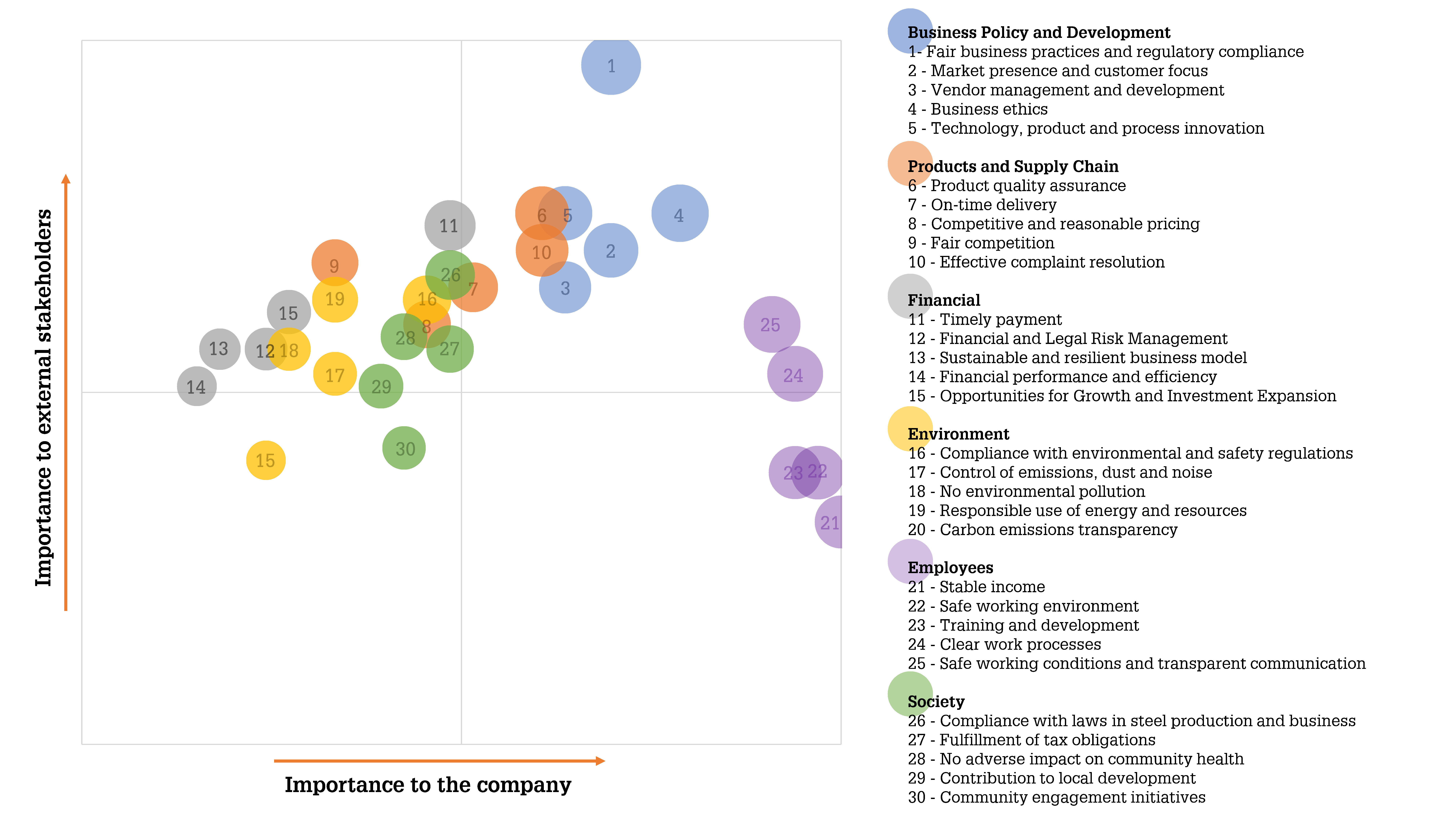
materiality matrix
 PRODUCT TRACEABILITY STATEMENT
Date 01st Jan 2026
At VAS Group – VAS Steel, we ensure that all sourcing information is managed and made available in a clear and transparent manner, enabling customers to trace the origin of the components used in our products.
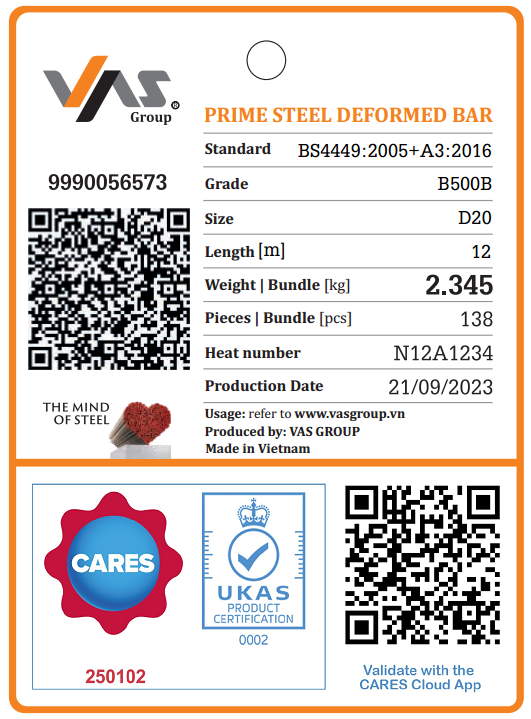
To enhance transparency and quality control, each production batch of billet and rebar is assigned a unique charge | heat number. Upon delivery, customers are provided with a Material Test Certificate [MTC], which includes full details on chemical composition, mechanical properties, and production origin. Through the heat number, the complete production history of the product can be traced.
In addition, VAS Group – VAS Steel attaches a product label to each bundle, displaying comprehensive product information and traceability data, ensuring identification and traceability throughout the supply chain. The company is progressively implementing digital traceability solutions, such as QR codes and internal data management systems, to improve accuracy and accessibility of information.
Through these measures, VAS Group – VAS Steel enables customers to confidently trace the origin and production history of its products, thereby enhancing transparency, building trust, and meeting industry standards as well as certification requirements such as CARES.
Note: Raw materials are sourced from multiple suppliers and accumulated at the same location. During production, the plant uses raw materials randomly based on operational conditions; therefore, it is not possible to determine exactly which scrap has been used for each specific production batch.
MODERN SLAVERY STATEMENT
Reporting Period: Financial Year 2025 [01/01/2025 – 31/12/2025]
VAS Group Nghi Son Joint Stock Company ["VASG", "the Company"] is committed to zero tolerance for all forms of modern slavery, including forced labour, debt bondage, deceptive recruitment, and the worst forms of child labour, within the Company's operations and throughout the supply chains over which the Company has influence.
This is the Company's first Statement, prepared on a voluntary basis to demonstrate a commitment to transparency with customers and partners in markets with high expectations for responsible supply chain governance. The Statement is structured to address the seven criteria prescribed under Section 16[1] of the Commonwealth Modern Slavery Act 2018 [CTH] of Australia. The Statement has been prepared following the completion of an independent audit of the Company's 2025 Financial Statements, to ensure that the figures referenced herein are supported by a reliable basis.
1. Reporting Entity
- Full name: Công ty Cổ phần Tập Đoàn VAS Nghi Sơn
- English name: VAS Group Nghi Son Joint Stock Company
- Abbreviated name: VAS Group
- Enterprise registration number: 2801115888
- Address: Nghi Son Iron and Steel Complex, Nghi Son Economic Zone, Nghi Son Ward, Thanh Hoa Province, Vietnam.
2. Structure, Operations and Supply Chain
VASG is organized under a Shareholders' General Meeting – Board of Directors [3 members] – Supervisory Board – Board of General Directors governance structure. The Company owns or controls a number of member entities, all operating within Vietnam, and all applying the Group's human rights policy and code of conduct.
The Company operates an integrated steelmaking plant in Nghi Son using Induction Furnace [IF] technology to produce steel billets, reinforcing steel bars, and wire rod coils. The Company directly employs approximately 850 workers, along with workers from service contractors [security, industrial cleaning, shift meal services, maintenance] who are regularly present within the plant premises.
The Tier 1 supply chain comprises approximately 500 suppliers, of which approximately 80% are headquartered in Vietnam. The main procurement categories include: metallurgical raw materials [ferrous scrap, metallurgical additives], production machinery and materials, personal protective equipment, outsourced on-site services, and transportation services.
Due to the nature of the Company's raw material procurement activities, the Company predominantly transacts with direct suppliers. As a result, the ability to trace and assess suppliers at deeper tiers of the supply chain [Tier 2 and beyond], particularly with respect to ferrous scrap sources, remains limited. The Company will progressively strengthen supply chain transparency through enhanced supplier requirements and improved due diligence practices.
These three product lines have been awarded Environmental Product Declarations [EPDs] in accordance with ISO 14025:2006 and EN 15804:2012+A2:2019/AC:2021, verified by the International EPD System [EPD codes S-P-13772, S-P-13773, and S-P-13774 respectively; valid until 10/05/2029].
3. Modern Slavery Risks
The Company assesses the risk of modern slavery in its direct operations in Vietnam as low. This assessment is based on the fact that the Company's operations are governed by the Vietnamese legal framework, under which the Labour Code 2019 and the Penal Code 2015 [as amended in 2017] strictly prohibit forced labour, human trafficking, and all forms of labour exploitation. In addition, the Company applies recruitment, labour management, and legal compliance procedures to safeguard workers' rights, and consistently fulfils its obligations with respect to wages, working hours, occupational safety, and social insurance as required by law. Specifically, Article 8 of the Labour Code 2019 prohibits forced labour in all its forms; Article 297 of the Penal Code 2015 criminalizes the offence of forced labour; and Articles 150–151 of the Penal Code criminalize human trafficking.
However, the Company acknowledges that the risk of modern slavery cannot be entirely eliminated and may primarily arise at upstream links in the supply chain, particularly with respect to raw materials and goods procured through suppliers or trading intermediaries. In such cases, the ability to trace and assess suppliers at deeper tiers of the supply chain [Tier 2 and beyond] remains limited, thereby increasing the risk of forced labour or labour exploitation existing outside the Company's direct sphere of control.
The Company therefore prioritizes supply chain risk management through supplier assessment, the integration of human rights compliance and modern slavery prevention requirements into the partner selection process, and the progressive enhancement of supply chain transparency and traceability.
The Company identifies the following material risks:
|
Activity |
Risk Level |
Rationale |
|
Direct workers at the plant |
Low |
Formal recruitment; subject to Vietnamese labour law. |
|
Domestic suppliers |
Low |
Can be assessed and engaged with directly; equally subject to Vietnamese labour law. |
|
Imported ferrous scrap |
Medium – High |
Difficult to trace origin; multiple intermediary tiers; risk of forced labour or labour exploitation at collection and sorting stages outside the Company's direct sphere of control. |
|
Other imported raw materials |
Medium |
Dependent on country of origin and level of supplier transparency. |
4. Actions Taken
The Company has issued and maintains a Human Rights Policy, a Code of Ethics and Conduct, and an ESG Policy, applicable to all member entities and workers of the Company. The Company also encourages its suppliers to develop and implement similar policies. These policies are publicly available at https://vasgroup.vn/sustainability/. The provision of personal protective equipment to workers is implemented in accordance with Circular No 20/2022/TT-BLĐTBXH on the principle of no cost to workers. The Company complies with Article 11 of the Labour Code 2019, which strictly prohibits employers from charging workers any fees during recruitment.
The Company maintains multiple grievance and whistleblowing channels, including an email address, suggestion boxes at the workplace, and information reception channels through the Human Resources Department. These channels are open to both the Company's own workers and contractors' workers. The Company is committed to maintaining the confidentiality of whistleblowers' information and to ensuring there is no retaliation against reports made in good faith.
With respect to the supply chain, the Company prioritizes ESG assessments for high-risk suppliers, based on the type of goods, procurement value, country of origin, and degree of impact on the Company's operations, with a focus on the high-risk categories identified in Section 3.
The Company acknowledges the following limitations requiring remediation:
- The Supplier Code of Conduct is currently in its final draft stage and has not yet been formally issued;
- The Company has not yet conducted on-site assessments of upstream overseas suppliers;
- The ability to trace and assess suppliers at deeper tiers of the supply chain remains limited, particularly for raw materials procured through trading intermediaries.
In the 2026 financial year, the Company plans to formally deploy an ESG screening questionnaire for new suppliers and to continue strengthening supply chain review activities to enhance the identification and management of modern slavery risks.
5. Effectiveness Assessment
The Board of Directors reviews the implementation outcomes of the Human Rights Policy at its annual meeting and approves the annual Statement. The Supervisory Board exercises independent oversight functions in accordance with applicable law and the Company's Charter.
The Company is also subject to annual independent external audits, including:
- Financial statement audit conducted by the Vietnam branch of Deloitte Vietnam Co., Ltd. - Independent Auditor's Report issued on 16 April 2026 for the financial year ended 31 December 2025;
- ISO 14001:2015 audit conducted by the Certification Centre [QUACERT] - certificate valid until 25 July 2028;
During the reporting period, no complaints were received through the whistleblowing channels in relation to modern slavery.
6. Consultation Process
The preparation of this Statement was coordinated by the Group's Legal Division, with the participation of the Supervisory Board, Human Resources Department, Supply Chain Department, and Technical & Production Department. The Company consulted each entity it owns or controls during the drafting process; as these entities all operate in the steel industry and within the territory of Vietnam, the content of this Statement applies uniformly across the entire Group.
This Statement has been approved by the Board of Directors of VAS Group Nghi Son Joint Stock Company and signed by the Chairman of the Board of Directors in the capacity of responsible member.